Homepage of Scott A. Wolpert
Distinguished Scholar-Teacher
University of Maryland
Mathematics Department
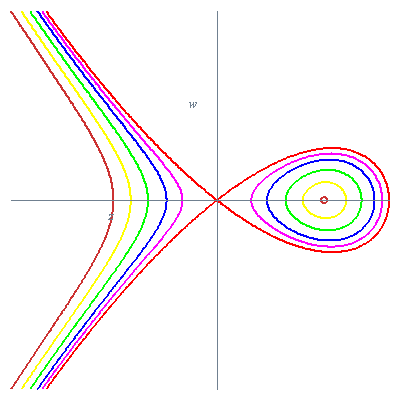
A degenerating family of elliptic
curves y^2=(1-x-t)(x^2-t).
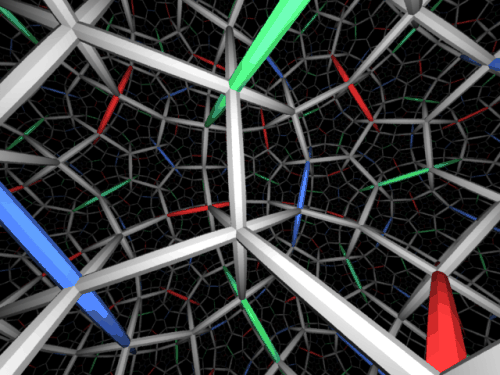
Hyperbolic Space Tiled with Dodecahedra, 2 by Charlie Gunn.
Copyright 1990 by The Geometry Center at the University of Minnesota. Used with permission.
This was no time for play.
This was no time for fun.
This was no time for games.
There was work to be done.
Dr.
Seuss
 The series is divergent;
therefore we may be able
to do something with it.
Oliver Heaviside
Education philosophy.
“The best teachers are usually those who are free, competent and willing to
make original researches in the library and laboratory. The best investigators are usually those who
have also the responsibilities of instruction, gaining thus the incitement of
colleagues, the encouragement of pupils, the observation of the public.” Daniel Coit Gilman - first President Johns
Hopkins University
Research interests.
I continue to be fascinated by the beauty
and intricacy of Riemann surfaces, especially descriptions by Fuchsian groups,
by cut-and-paste constructions and as solutions of algebraic equations. Klein's
Riemann surface with 168 symmetries is a beautiful example. Large
symmetry tessellations
of the hyperbolic plane are just as fascinating. My early and most recent research concerns
the variation of Riemann surfaces. Variations are prescribed by analytic
means or by varying the geometric assembly. The Fenchel-Nielsen
construction of surfaces with hyperbolic metric from hyperbolic
right-hexagons leads to a description of the Teichmueller space of Riemann
surfaces by specifying twist-length parameters. Thurston’s
earthquakes provide a variation by shearing along a measured geodesic
lamination. Analytic variations in the style of Kodaira-Spencer are
provided by solving the Beltrami differential equation.
I continue to study the Weil-Petersson (WP) geometry for the Teichmueller space. Understanding convexity and curvature are basic matters. The WP metric completion of the Teichmueller space, is a stratified CAT(0) metric space: a space where the distance and angle measurements for a triangle are bounded by the corresponding measurements for a Euclidean triangle with the corresponding edge-lengths. CAT(0) metric spaces are spaces of generalized non positive curvature. An overview of selected results on the WP metric is given in the research brief and in the introduction of the Geometry of the WP completion. In the second reference, the CAT(0) geometry and the behavior of geodesics in-the-large are studied in detail. An asymptotic expansion for the WP metric is provided; a classification of flats is provided and a (pre)compactness theorem for the space of geodesics is provided. A direct proof is also provided that the mapping class group is the full group of WP isometries. Jeff Brock has studied the WP geometry at large-scale and provided an approximate combinatorial model for the geometry. Teichmueller space with the WP metric is quasi-isometric to the Hatcher-Thurston pants graph. Maryam Mirzakhani has studied WP volumes of moduli spaces of bordered Riemann surfaces with fixed boundary lengths. She has presented a recursive scheme for determining the volumes and established that the recursion satisfies the string equation and dilaton equation. The recursion is the Witten-Kontsevich conjecture. She has also studied for a Riemann surface the counting function for simple closed curves in terms of length. A highlight of more recent progress is presented in Weil-Petersson perspectives. An overview of results and research questions are presented on comparison of classical metrics for Teichmueller space, on the WP synthetic geometry and on characteristic classes. The intrinsic local WP geometry is examined in Behavior of geodesic-length functions on Teichmueller space. Geodesic-length function expansions are developed for the pairing of WP gradients, Hessian and covariant derivative of the gradient. Comparability models for the metric are presented including for Fenchel-Nielsen coordinates. The behavior of geodesics near the completion locus is analyzed and a simple model is presented for the Alexandrov tangent cone at the completion. Convexity properties of Weil-Petersson geodesics are further investigated in Extension of the Weil-Petersson connection. A normal form is presented for the Weil-Petersson Levi-Civita connection for pinched hyperbolic metrics. The normal form is used to establish approximation of geodesics in boundary spaces.
Leon Takhtajan and coauthors have of late studied the infinite dimensional universal Teichmueller space T(1), showing that T(1) carries a new structure of a complex Hilbert manifold and that the connected component of the identity is a topological group. They define the WP metric on T(1) by Hilbert space inner products on tangent spaces, compute its Riemann curvature tensor, and show that the metric is Kaehler-Einstein with negative Ricci and sectional curvatures. The universal Liouville action of a cocycle plays an important role in the considerations. They further introduce and compute Mumford-Miller-Morita characteristic forms for the vertical tangent bundle of the universal Teichmueller curve fibration over the T(1). As an application, they obtain our earlier curvature formulas for the finite-dimensional Teichmueller spaces from the formulas for the universal Teichmueller space. Curt McMullen has recently shown that the WP metric on Teichmueller space can be reconstructed from the dimensions of dynamical quantities, such as measures on the unit circle and limit sets on the sphere. His approach reveals a connection between Hausdorff dimension, norms of holomorphic forms, and the central limit theorem for geodesic flows, especially the variance of observables of mean zero. The elements of consideration are mediated by the thermodynamic formalism, which leads to parallel results for Julia sets, polynomials and Blaschke products.
I have also considered
questions coming from mathematical physics, first from string theory,
second from the spectral theory of the Laplacian and recently from
considerations of quantum chaos. I have been concentrating on questions
in the spectral theory of Riemann surfaces, such as isospectrality ("Can
you hear the shape of the drum?"), the existence of embedded eigenvalues
for surfaces with cusps and the nature of high-energy eigenfunctions. In
a collaboration with Carolyn Gordon and David Webb we found the first example
of different shaped domains in the Euclidean plane with the same frequency
spectrum for the Laplacian. Simulated animated drum vibrations for sound-alike
domains can be viewed at Toby Driscoll's site; a
writeup and a small catalog of pairs of sound-alike domains is available
from Peter Buser, John Conway, Peter Doyle and Klaus-Dieter Semmler at the site.
For the special Riemann surfaces which are arithmetic the above
questions overlap with considerations from classical analytic number theory,
such as the Ramanujan-Petersson conjecture on the magnitude of certain Fourier
coefficients and the Lindeloef conjecture on the magnitude of the L-function on
its critical line.
Research manuscripts and lectures (in .dvi and .pdf format)
On the symplectic geometry of deformations of a hyperbolic surface, Ann. of Math. (2) 117 (1983), no. 2, 207–234.
Chern forms and the Riemann tensor for the moduli space of curves, Invent. Math. 85 (1986), no. 1, 119–145.
The
hyperbolic metric and the geometry of the universal curve, J. Differential Geom. 31 (1990), no. 2, 417–472.
Asymptotic
relations among Fourier coefficients of automorphic eigenfunctions,Trans. AMS 356 (2004), 427-456.
Automorphic
coefficient sums and the quantum ergodicity question, Contemp. Math., vol.
256, 2000.
The Modulus of
Continuity for $\Gamma_0(m)\backslash H$ Semi-Classical Limits, Comm. Math.
Phys., vol. 216, 2001.
Semiclassical
Limits for the Hyperbolic Plane, Duke Math. J., vol. 108, 2001.
A research brief
on the Weil-Petersson metric, in PDF Kluwer
Encyc.of Math., Supp. III, 2001. A precis current only as of March
2000. For a current discussion of the global geometry of WP geodesics see
the introduction of the following manuscript. For further results also
see the work of: Jeffrey Brock and with the coauthors Benson Farb, and Yair
Minsky; Maryam Mirzakhani; Georgis Daskalopoulos and Richard Wentworth; Zeno
Huang; Howard Masur; Michael Wolf; Sumio Yamada.
Geometry of
the Weil-Petersson completion of Teichmueller space, in PDF
Surveys in Differential Geometry, VIII: Papers in Honor of Calabi, Lawson, Siu
and Uhlenbeck, editor S. T. Yau, International Press, Nov. 2003.
Hyperbolic
3-manifolds with nonintersecting closed geodesics, in PDF joint
with Ara Basmajian, Geom. Dedicata., vol. 97, 2003.
Convexity
of geodesic-length functions: a reprise,
in PDF
Weil-Petersson perspectives, in
Problems on mapping class groups and related topics, Proc. Symp. Pure
Math., 74, 2006.
Cusps and the
family hyperbolic metric, Duke Math. Jour., vol. 138, no. 3, 423-443, 2007.
Lecture:
The CAT(0) geometry of Teichmueller space, University of Chicago, April 10,
2006
Lecture:
Estimating hyperbolic Green's functions for degenerating surfaces,
University of Chicago, April 11, 2006
Behavior of geodesic-length functions
on Teichmueller space, Jour. Diff. Geom., 79 (2008), no. 2,
277-334.
Grafting hyperbolic metrics and
Eisenstein series, joint with Kunio Obitsu, Math. Annalen, 341
(2008), 685-706.
WP Metric Geometry Quick Overview
Extension of the Weil-Petersson connection, Duke Math. J., 146 (2009), no. 2, 281-303.
Topological dynamics of the Weil-Petersson geodesic flow, joint with Mark Pollicott and Howard Weiss, Advances in Math. 223 (2010), 1225-1235.
The Weil-Petersson metric geometry, in Handbook of Teichmueller theory, Vol. II, IRMA Lectures, European Math. Soc., 2009.
Understanding Weil-Petersson curvature, Geometry and Analysis, vol. 1. Advanced Lectures in Mathematics, Intl. Press, (2010), 495-512.
A cofinite universal space for proper actions of mapping class groups, joint with Lizhen Ji, in Contemp. Math., 510, AMS, 2010.
A Weil-Petersson sampler, a pdf presentation with a highlight of themes, current understanding and research.
Families of Riemann surfaces and Weil-Petersson Geometry, a 2008 overview on WP geometry - a preliminary plan for the following CBMS lectures is included.
Table of Contents: NSF CBMS Lectures, Families of Riemann Surfaces and Weil-Petersson Geometry, Central Connecticut State University, AMS-CBMS Regional Conference Series
Surveys
in Differential Geometry, Vol. 14 (2009): Geometry of Riemann surfaces and
their moduli spaces, a collection edited jointly with Lizhen Ji and
Shing-Tung Yau.
Geodesic-length functions and the
Weil-Petersson curvature tensor, Jour. Diff. Geom., 91 (2012), 321-359.
Lectures and notes: Mirzakhani's volume recursion and approach for the Witten-Kontsevich theorem on moduli tautological intersection numbers, lecture notes from Park City Math Institute, Graduate Summer School, 2011.
On families of holomorphic differentials on degenerating annuli, Contemp. Math., 575, Amer. Math., 2012.
Infinitesimal deformations of nodal stable curves, ArXiv 1204.3680
Products of twists, geodesic-lengths and Thurston shears, ArXiv 1303.0199
Already happened:
Workshop:
Dynamics of the Weil-Petersson geodesic flow
June 18 to June 22,
2012
American Institute
of Mathematics, Palo Alto, CA
Park City Math Institute – Graduate Summer School – Moduli Spaces of Riemann surfaces
July 3-23, 2011, Park City, UT
Geometry and Analysis of
Riemann Surfaces and their Moduli
September 24-26, 2010, University of Maryland, College Park
A birthday conference – group
picture – pics

A follow up to the CCSU NSF CBMS conference: Teichmueller theory
April 24-25, 2010, Central Connecticut State University
NSF CBMS Conference on Families of Riemann Surfaces and Weil-Petersson Geometry
July 20-24, 2009 Central Connecticut State University
Jeffrey K. McGowan and Eran Makover, Organizers
And a musical
composition:
The Mathematician by Philip Momchilovich © 2010.mp3
Philip Momchilovich is a Washington DC composer, conductor
and educator.
http://www.washingtonpromusica.org/
Some fun math
links:
NonEuclid- An
introduction to hyperbolic geometry and a Java-based hyperbolic geometry
drawing program.
Platonic tilings of
Riemann surfaces
Hyperbolic
Tessellations, by David E. Joyce
Hyperbolic Planar
Tessellations, by Don Hatch
The University of Minnesota Geometry Center
Virtual Polyhedra
- A collection of thousands of virtual reality polyhedra by George W.
Hart.
Penguins on the hyperbolic plane, by Misha Kapovich